
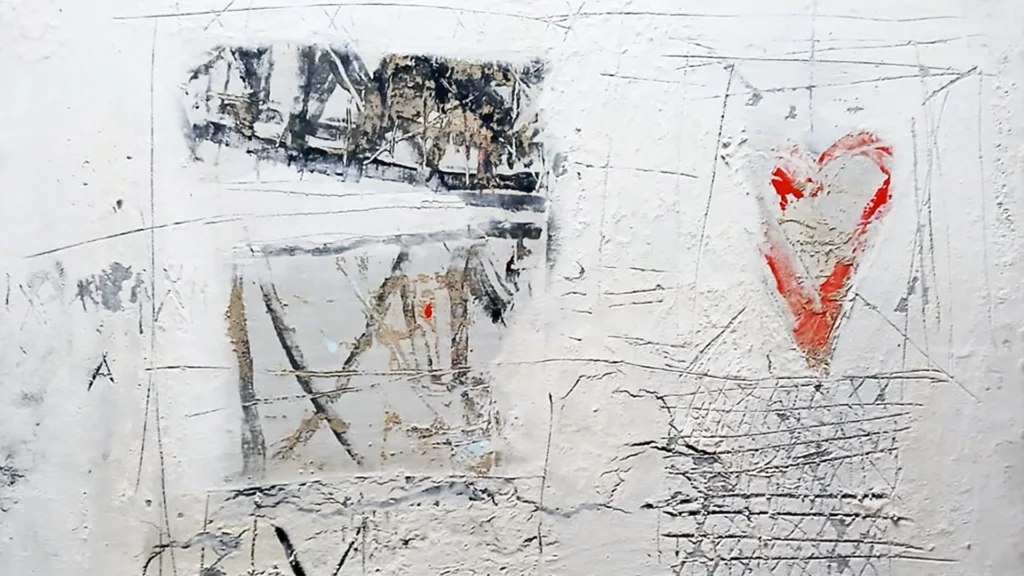
As of March 27, 2026, Dissociazione (1991–1994), a fresco by the Friulian master Giorgio Celiberti, becomes part of the permanent collection of the National Gallery of Modern and Contemporary Art (GNAMC).
At the heart of the artist’s research lies humanity in its most essential form, understood as a relationship between individuals and as a mysterious tension between earth and sky, between memory and the future, and between individual experience and the universal dimension of existence.
A pivotal moment in Celiberti’s life and artistic journey came in 1965, when he visited the Terezín concentration camp in the Czech Republic. The graffiti, letters and poems left by the deported Jewish children became a central element of his artistic language, which has remained deeply rooted in the theme of memory.
Celiberti’s artistic vision is not driven by economic or professional considerations, but rather takes shape as an inner mission. His works form a cohesive body, a “silent family”, reflecting a constantly evolving journey of spiritual exploration in which each work is not an end point, but a stage in an ongoing process of transformation. Through his art, the Maestro connects with humanity—with its events and emotions—becoming a keeper of memories of pain, feelings and experiences.
The large fresco, a landmark in the artist’s research, brings together the elements of the sign-based visual language he developed in the mid-1960s: the tactile roughness of the surface, childlike symbols, and the primitive colours of white, red and black. While the palette of his works from those years was dramatic—with large expanses of black from which red hearts and other signs emerged like wounds—Dissociazione, like his other works from the first half of the 1990s, reveals a markedly lighter palette. This shift represents a break with the darker periods of the past—a dissociation, indeed—and expresses a hope for a return to life, as an impassioned call for forgiveness.
The addition of Dissociazione enriches the collection, reinforcing the shared commitment of the Gallery and the artist to presenting the public with a profound body of work that brings memory and matter together in a universal human experience, creating a dialogue between past and present.
BIOGRAPHICAL NOTES
Giorgio Celiberti was born in Udine in 1929 and began painting at a very young age. At just eighteen, he took part in the 1948 Venice Biennale. After studying at art school, he worked in Emilio Vedova’s studio and shared the Venetian artistic experience with Tancredi Parmeggiani.
In the 1950s, he moved to Paris, where he came into contact with the main currents of the European avant-garde. He subsequently lived in Brussels on a scholarship from the Italian Ministry of Education, and later in London, during a period marked by the Expressionism of Francis Bacon and Graham Sutherland. His restless spirit also led him to travel to the Americas and the Caribbean, including Mexico, Cuba, Venezuela and the United States, absorbing a range of international influences. After a period in Rome, he returned to Udine in the mid-1960s, embarking on a new phase in his artistic research.
In 1965, a visit to the Terezín concentration camp marked a decisive turning point: the graffiti and poems left by the deported Jewish children became a central element of his artistic language.
Alongside painting, Celiberti also developed his sculptural practice extensively, working with bronze, aluminium, stone, ceramics and glass. His works often depict animals and archaic figures—horses, horsemen, goats, birds and cats—alongside symbolic forms such as stelae, fragments and bas-reliefs evoking ancient civilisations.
Throughout his career, he took part in the Venice Biennale and the Rome Quadriennale on numerous occasions, receiving many awards and holding more than two hundred solo exhibitions in Italy and abroad, in cities including New York, Paris, London, Barcelona, Madrid and Brussels.
Among his monumental works is an 800-square-metre fresco, created between 1989 and 1991 at the convention centre of the Kawakyu Hotel in Japan. In 2011, he donated a large stele to the Terezín Fortress Memorial. In subsequent years, his works entered important collections, including those of the Würth Museum, MART – Museum of Modern and Contemporary Art of Trento and Rovereto, and the National Gallery of Modern and Contemporary Art.
In recent years, he has continued to exhibit and create installations in Italy and abroad, also collaborating with Philippe Daverio and Marco Nereo Rotelli. In 2025, one of his stelae was acquired by the European Parliament for its permanent collection in Brussels. In the same year, he was received by Pope Leo XIV, to whom he donated a sculpture inspired by the Jerusalem Cross. In 2026, he took part in his sixth Venice Biennale, exhibiting alongside his namesake grandson, who was making his debut at the event.
He lives and works in Udine.