
Connessioni urbane. Awards Ceremony and Finalists’ Exhibition
Wednesday 28 January, 5.30 pm
Speakers:
Renata Cristina Mazzantini, Director, GNAMC
Andrea Marchiori, CEO, Techbau
Mario Cucinella, Mario Cucinella Architects
Maurizio Veloccia, Councillor for Urban Planning, Roma Capitale
On Wednesday 28 January, the Galleria Nazionale d’Arte Moderna e Contemporanea will host the announcement of the winner of the Connessioni Urbane competition, a cultural initiative arising from the collaboration between the GNAMC and Techbau S.p.A., dedicated to promoting contemporary art as a tool for urban regeneration and dialogue with the city.
Cristina Mazzantini – Director, GNAMC
“Stimulating and rewarding contemporary creativity through open competitions dedicated to young people is part of the GNAMC’s history and mission. We received no fewer than 41 proposals, many of them of great interest. I would like to thank the academies and universities that involved professors and students, encouraging them to engage with such an important theme for the capital. This success is the result of a virtuous inter-institutional collaboration and a fruitful public-private partnership.”
The competition is situated within an urban context of great significance for the city of Rome, in a strategic area just a short distance from Vatican City, marked by the presence of Roma San Pietro railway station, the capital’s first railway station, inaugurated in 1894 and now used by millions of passengers every year.
For local residents and those who live and work in the area on a daily basis, this site has long represented a condition of unresolved waiting. Today, after an extended period of time, the area is finally giving way to an urban regeneration project capable of restoring continuity, services and a sense of centrality to a neighbourhood that for years had remained in a state of suspension.
Andrea Marchiori, CEO, Techbau S.p.A.
“Campus San Pietro embodies our approach to urban regeneration in concrete terms, understood as the integration of architecture, public space and sustainability. It is within this framework that the Connessioni Urbane competition has been developed, in collaboration with the Galleria Nazionale d’Arte Moderna e Contemporanea, introducing contemporary art as a structural component of the project. The development has been conceived in accordance with ESG principles and with the aim of achieving BREEAM Excellent certification.”
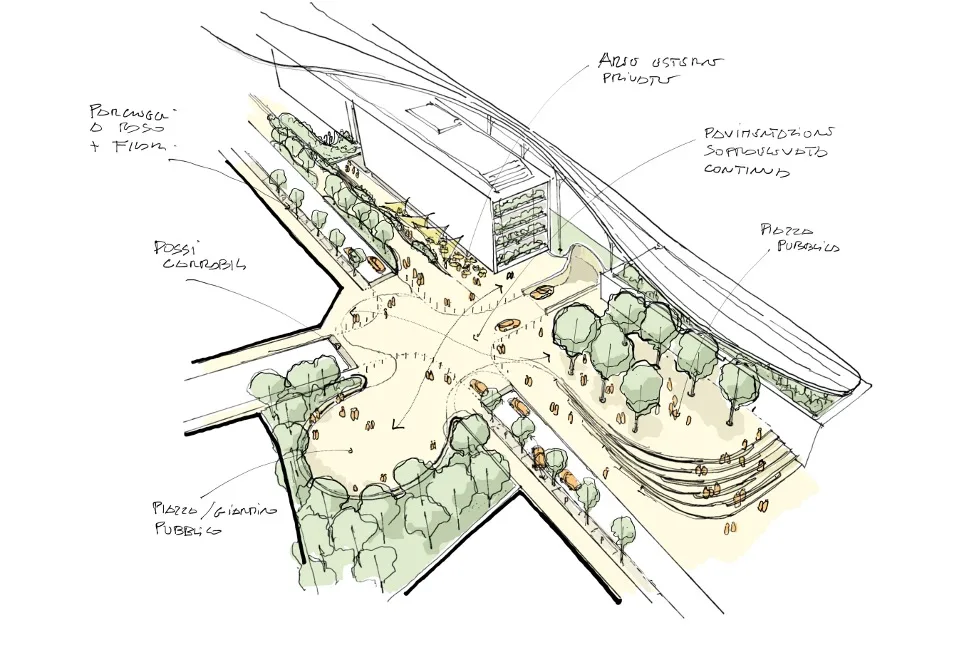
As part of this process of transformation, the new multi-purpose building on Via del Crocifisso is taking shape, designed by MCA – Mario Cucinella Architects and developed by Techbau S.p.A. The building will accommodate student housing, commercial spaces, green areas and facilities for public events. It is conceived as an integrated urban ecosystem, intended to restore quality, services and new connections to a strategic area of the capital, with excellent transport links and a strong cultural, academic and international presence. The project has also been made possible through collaboration with the Municipality of Rome, which has shared from the outset a vision focused on urban quality and the future of the city.
Maurizio Veloccia – Councillor for Urban Planning, Roma Capitale
“Together with the winners of this competition, we are demonstrating today how the public and private sectors can work together towards shared and collective regeneration. We are also celebrating talent and creativity placed at the service of a place that is being reborn and brought back to life: this, too, is urban regeneration. The new multi-purpose building on Via del Crocifisso, which after twenty years is recovering and bringing back to life an unfinished work and an urban wound in the heart of our city, is destined to become a new point of reference for the neighbourhood. In this initiative, the Administration and the property owner have worked together to improve the original project and make the public spaces more accessible and collective, also thanks to the contribution of the Galleria Nazionale d’Arte Moderna e Contemporanea which, through the installation of artworks, will further enhance the valuable urban context in which the urban development programme is situated.”
It is within this context that the Connessioni Urbane competition was created, involving young artists invited to engage with a symbolic site within Rome’s urban transformation: a wall 145 metres long and 10 metres high, located between the new “Crocifisso” multi-purpose building and Roma San Pietro railway station. From an element of separation, the wall will be reinterpreted as a narrative surface, capable of accommodating a permanent and publicly accessible artwork, becoming an integral part of the urban landscape and the everyday life of the neighbourhood.
During the event, the 10 finalist projects selected by the jury will be presented and the winner announced. The winning intervention will be realised within the multi-purpose building and will become a permanent part of the new urban landscape of the area. The finalist projects are on display in the exhibition at the Galleria’s Soppalco Aldrovandi, which can be visited until 8 February.
Mario Cucinella, Architect, Founder & Creative Director of MCA – Mario Cucinella Architects
“The intervention on the building that will accommodate the student residence and street-level services is a regeneration project intended to fill a major urban void in the heart of the city of Rome. As conceived, the project aims to enable new urban relationships that have until now been denied, through the reactivation of the street by means of local initiatives and the redevelopment of the square and small park.
In this context, Connessioni Urbane has the merit of initiating a reflection on the relationship with the large railway retaining wall. The challenge, therefore, was to find a language that, in contrast with a rational building embodying a specific construction method, could unlock an expressive code capable of engaging with that contrast: the artwork, with its organic matrix, interacts with the rationality of its surroundings, creating a free and painterly creative form that advances the process of urban regeneration. It is no coincidence that Architecture, Art and Public Space, together with the functions they accommodate, are the ingredients from which the City is made.”
The Via del Crocifisso project thus emerges as a virtuous model of urban transformation, in which architecture, art and public space contribute to the construction of a more inclusive and liveable city, generating urban, social and cultural value and contributing to a shared vision of quality in public space.
Ranking and Scores of Finalist Candidates