
Curated by Alessio Alessandrini
The Galleria Nazionale d’Arte Moderna e Contemporanea presents From the 1948 Venice Biennale to the Present, a temporary exhibition featuring a selection of works by the distinguished Friulian master Giorgio Celiberti, offering an insight into the profound meaning of his art. The exhibition provides an opportunity to explore the artist’s research through works including 900 (1998, acrylic on canvas) and Diario di bordo (1997, acrylic on canvas), which testify to the continuity of his artistic journey and serve as witnesses to, and vehicles for, the memory of a century—the twentieth century—and of the emotions and experiences that shaped it. To understand their meaning in its most intimate dimension, it is necessary to know the artist not only through evidence of his talent, but also as a man, with his experiences and humanity: a creatively independent personality who was at the same time generous, sociable and entirely free of any elitist attitude. Celiberti does not belong to any clearly defined artistic school or movement; rather, his research develops from an inner necessity rather than from adherence to aesthetic programmes.
In the 1960s, the artist embarked on a new and personal path, abandoning the language through which he had previously expressed himself, which can be associated with Expressionism.
This turning point is often linked to his encounter with the memory of the Holocaust and with the city of Terezín, an experience that deepened his profound compassion for violated innocence and also found expression in commemorative works. This transformation appears to have arisen from a profound need for inner recognition and artistic autonomy, almost as a necessary transition towards a more universal dimension of his language. Celiberti’s very presence evokes something archaic and primordial: in his face and gestures, one senses an almost ritual dimension, reminiscent of the shaman, the priest or the ancient maker of images. This dimension is also reflected in his art, which seems to establish an ideal connection with the artists of the prehistoric caves of Lascaux and Altamira, where painting served not only an aesthetic purpose but also a magical and symbolic one. It is no coincidence that Celiberti often uses primary colours and essential signs, as though seeking to recover an original language capable of grasping the fundamental paradigms of life.
In his work emerges the idea that naming things somehow means creating them, restoring to them a lost meaning. After the tragedies of history, reality appears to require “renaming” in order to recover a primitive purity. For Celiberti, art is neither a profession nor an activity subject to economic considerations, but a true inner mission, and his works come together to form a great silent family. The creative process thus becomes a form of meditation and spiritual inquiry, in which the work is never a definitive point of arrival, but rather a stage in a constantly evolving journey. At the conceptual core of his research lies humanity in its most essential form, understood as a relationship between individuals and as a mysterious tension between earth and sky, memory and the future, individual experience and the universal dimension of existence. Alongside the exhibition, Dissociazione (1991–1994, fresco) will be displayed and will become part of the Gallery’s permanent collection.
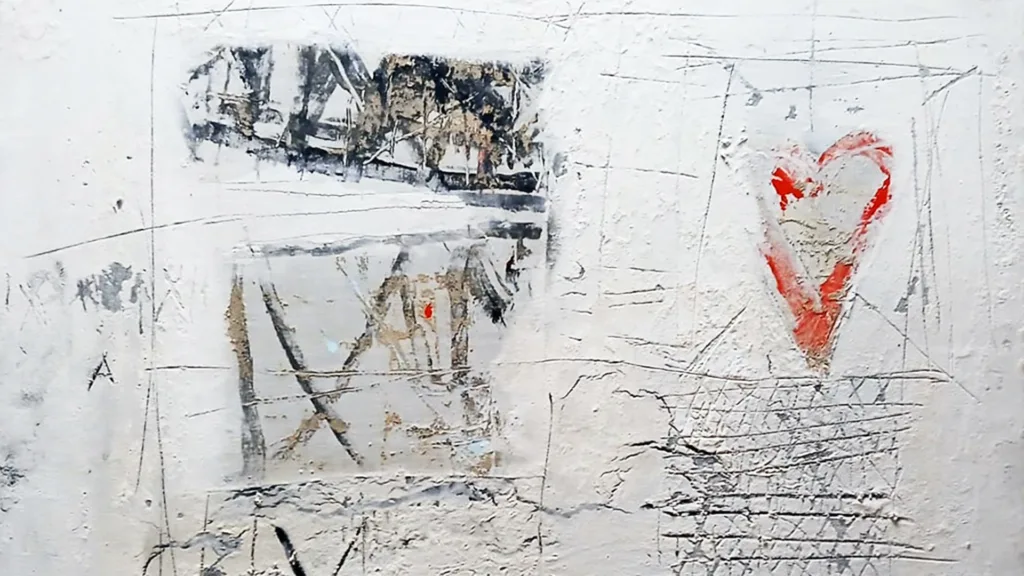
Hearts, letters, erasures and windows positioned high above, beyond reach, become elements of the artist’s visual language through material roughness and the use of childlike symbols. The primitive colours, which become lighter in contrast to the dark, dramatic palette of his other works, move away from the most tragic periods and, by “dissociating” themselves, become a wish for a return to life, like a heartfelt call for forgiveness. With the addition of Dissociazione to the Museum’s collection, the Galleria Nazionale d’Arte Moderna e Contemporanea welcomes a significant work from the artist’s career, strengthening the dialogue between the collection and an artistic research that interweaves memory, matter and the universal dimension of human experience.
GIORGIO CELIBERTI. From the 1948 Venice Biennale to the Present
Galleria Nazionale d’Arte Moderna e Contemporanea
Curated by Alessio Alessandrini
Viale delle Belle Arti 131, Rome
Dates
28 March 2026 – 3 May 2026
Tickets
The exhibition is included in the admission ticket to the Galleria Nazionale d’Arte Moderna e Contemporanea.
BIOGRAPHICAL NOTES
Giorgio Celiberti was born in Udine in 1929 and began exploring painting at a very young age. At just eighteen, he participated in the 1948 Venice Biennale. After studying at art school, he worked in Emilio Vedova’s studio and shared the Venetian artistic milieu with Tancredi Parmeggiani. In the 1950s, he moved to Paris, where he came into contact with the principal currents of the European avant-garde. He subsequently lived in Brussels on a scholarship from the Italian Ministry of Education, and later in London, during a period marked by the Expressionism of Francis Bacon and Graham Sutherland. His restless spirit also led him to travel throughout the Americas and the Caribbean, including Mexico, Cuba, Venezuela and the United States, absorbing international influences. After a period in Rome, he returned to Udine in the mid-1960s, beginning a new phase in his artistic research. In 1965, a visit to the Terezín concentration camp marked a decisive moment: the graffiti and poems created by deported Jewish children became a central focus of his artistic vision. Alongside painting, he also developed an intense sculptural practice, working with bronze, aluminium, stone, ceramics and glass. His works often depict animals and archaic figures—horses, horsemen, goats, birds and cats—alongside symbolic forms such as stelae, fragments and bas-reliefs that evoke ancient civilisations.
Throughout his career, he participated several times in the Venice Biennale and the Rome Quadriennale, receiving numerous awards and presenting more than two hundred solo exhibitions in Italy and abroad, in cities including New York, Paris, London, Barcelona, Madrid and Brussels. Among his monumental works is an 800-square-metre fresco created between 1989 and 1991 at the Kawakyu Hotel’s congress centre in Japan. In 2011, he donated a large stele to the Terezín Fortress Memorial. In subsequent years, his works entered important collections, including the Würth Museum, MART – Museum of Modern and Contemporary Art of Trento and Rovereto, and the Galleria Nazionale d’Arte Moderna e Contemporanea.
In recent years, he has continued to exhibit and create installations in Italy and abroad, also collaborating with Philippe Daverio and Marco Nereo Rotelli. In 2025, one of his stelae was acquired by the European Parliament for its permanent collection in Brussels. That same year, he was received by Pope Leo XIV, to whom he donated a sculpture inspired by the Cross of Jerusalem. In 2026, he participates in his sixth Venice Biennale, exhibiting alongside his grandson of the same name, who is making his debut at the event.
He lives and works in Udine.