
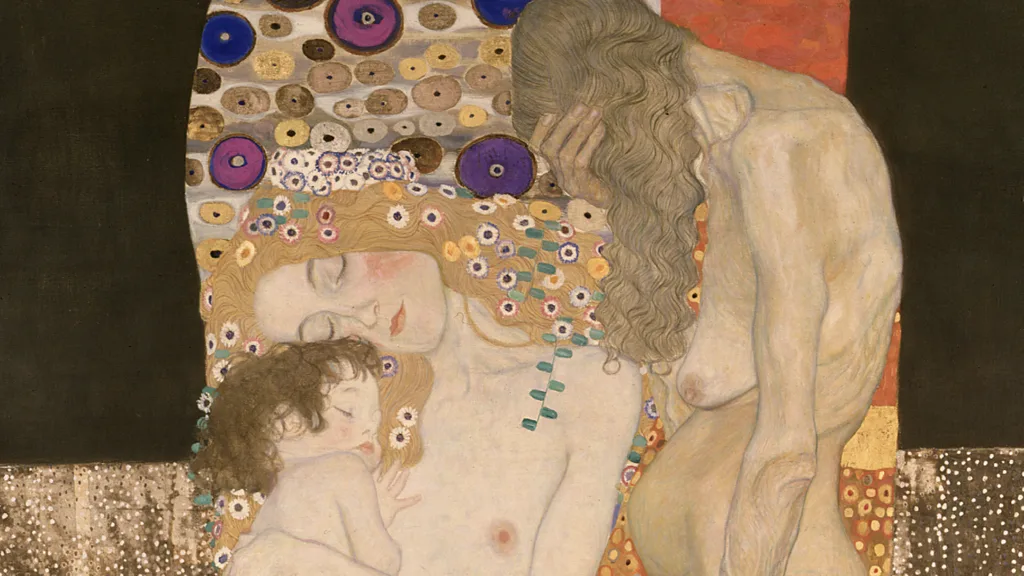
On the eightieth anniversary of women gaining the right to vote in Italy, the Galleria Nazionale d’Arte Moderna e Contemporanea readily agreed to loan Gustav Klimt’s masterpiece Le tre età (The Three Ages) to Palazzo Bonaparte for the exhibition Novecento italiano. Opere dalla Collezione Generali (Italian Twentieth Century. Works from the Generali Collection), 14 July–23 August 2016. Dedicated to the Ina Assitalia collection, the exhibition is organised by the Generali Group to mark the tenth anniversary of its “Generali Valore Cultura” project.
Painted in 1905 and presented that same year at the second exhibition of the Deutscher Künstlerbund in Berlin, the work was shown at the 1910 Venice Biennale, where it received considerable acclaim. It was acquired by the Italian State in 1911 following the International Exhibition in Rome, held to celebrate the fiftieth anniversary of Italian unification, and was subsequently assigned to what was then the Galleria Nazionale d’Arte Moderna.
It is a masterpiece whose absence from the Galleria is difficult to contemplate today, even for a limited period.
Le tre età (The Three Ages) is regarded as one of the pinnacles of European Symbolism, marking Klimt’s definitive departure from academic models and affirming his artistic maturity within Art Nouveau. Emblematic of Klimt’s so-called Golden Period, the painting is distinguished by the extensive use of precious metal leaf and decorative motifs inspired by the Byzantine mosaics of Ravenna. These include not only gold, but also platinum and silver, prominent in the backgrounds and in the ornamentation of the figures, where they evoke a sense of spiritual transcendence. The metallic reflections create shimmering effects that draw the eye, leading it into the most intricate details of the background before bringing it to rest on the void. This black, rectangular void is set within the perfectly square canvas, dividing it into horizontal and vertical bands according to carefully calculated, harmonious proportions.
Klimt combines figuration and abstraction with remarkable sophistication. The decorative patterns of the backgrounds evoke arabesques, suggesting crystalline rainfall or a star-studded firmament, while their motifs may be read as allusions to fertility and the generation of life. Circular forms reminiscent of ova and cells appear in shades of purple, blue, yellow and gold. These vivid, luminous colours counterbalance the subdued tones of ashen grey and the opacity of black.
Every element of the work contributes to a meditation on time, human existence, the inevitable fragility of the body and the continuity of life. The result is a powerful allegory of the essential nature of the feminine, casting woman as both the origin and guardian of existence. The extraordinary expressive force of the work, at once erotic and melancholic, and capable of eliciting emotions ranging from tenderness and seduction to compassion, has made it an icon of the female condition in the early twentieth century.
For this reason, the decision to make one of the greatest masterpieces in the collection of the Galleria Nazionale d’Arte Moderna e Contemporanea freely accessible to the widest possible public during the summer carries a significance that extends beyond the museum loan itself. In the year marking both the eightieth anniversary of the birth of the Italian Republic and the eightieth anniversary of women’s right to vote and to stand for election, the loan of Le tre età (The Three Ages) is intended as a tribute to the role women have played in the country’s civic and cultural history.
Novecento italiano. Opere dalla collezione Generali
ROMA, PALAZZO BONAPARTE
Piazza Venezia, 5
00187 Roma
OPENING HOURS
Daily
10:00 am–8:00 pm
T: +39 06 87 15 111
Mail: info@arthemisia.it
www.mostrepalazzobonaparte.it