Curated by Shai Baitel and Andrea Tarsia
The Galleria Nazionale d’Arte Moderna e Contemporanea presents Marina Abramović: Historical Works and Transforming Energy, an exhibition marking the artist’s 80th birthday that brings together some of the most significant historical works of her career alongside a selection of Transitory Objects. Spanning different phases of her artistic practice, the exhibition explores the relationship between the performative dimension of the body and the slower, more profound temporality of matter. Following its presentation at the Gallerie dell’Accademia in Venice on the occasion of the 61st International Art Exhibition – La Biennale di Venezia, the exhibition arrives in Rome in an expanded version.
Curated by Shai Baitel, Artistic Director of the Modern Art Museum (MAM) in Shanghai, in close collaboration with the artist, the exhibition situates Transforming Energy within the broader evolution of Marina Abramović’s artistic practice.
The Historical Works section, curated by Andrea Tarsia, features several iconic works that have shaped the history of performance art and Abramović’s own practice, including Imponderabilia (1977), Balkan Baroque (1997) and The Artist Is Present (2010). Through these works, the exhibition highlights the central importance Abramović has placed on the body, presence, duration and the relationship with the audience, elements that, over the decades, have transformed performance into a space of experience and encounter.
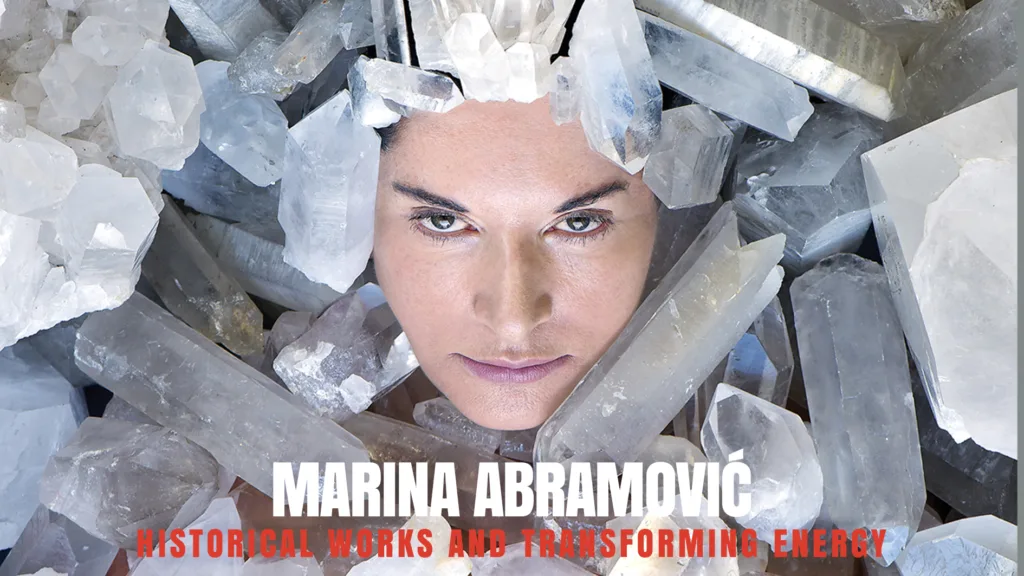
At the heart of the exhibition is Transforming Energy, a body of work comprising a selection of Transitory Objects, a series Abramović has been developing for more than three decades. Stone beds, structures and sculptural forms made from quartz, amethyst, agate and other minerals are conceived as instruments through which visitors can engage directly with the work. By lying down, sitting or remaining still upon these structures, visitors are invited to activate what the artist describes as a process of “energy transmission.” The work thus extends beyond its sculptural form, finding completion through the presence and physical experience of those who engage with it.
With the Transitory Objects, Abramović’s exploration of the body moves beyond the immediacy of performance to engage with a different conception of time: the geological time of minerals and the Earth. The materials used in these works are the products of natural processes unfolding across geological eras, introducing into their relationship with the body a timescale profoundly different from that of human experience. The body thus becomes a meeting point for different temporalities, energies and forms of matter.
The artist’s interest in crystals and their relationship with energy and the human body developed particularly following her journey along the Great Wall of China in 1988. During this experience, Abramović encountered principles of traditional Chinese medicine that helped shape her thinking about the relationship between the body, energy and matter. Over the following decades, the Transitory Objects became a significant component of her practice, bringing materials formed over geological eras into the exhibition space and presenting them as instruments for a direct and conscious engagement with the body.
The dialogue between historical and more recent works allows visitors to trace the continuity of Marina Abramović’s artistic practice, revealing how themes such as presence, duration, the body, energy and human connection have been continually reconsidered and transformed over time. The exhibition charts a path from her early experiments in performance to a conception of the artwork as a space of encounter, in which the audience is no longer merely an observer but an integral part of the experience.
It is within this context that the celebration of the artist’s 80th birthday takes on particular significance. Italy’s Minister of Culture, Alessandro Giuli, describes the occasion as an opportunity to pay tribute to a “pioneer of performance art” who is now a leading figure on the international art scene. For Renata Cristina Mazzantini, Director of the GNAMC, the presentation of historical and recent works together reveals the richness of an artistic practice spanning Abramović’s entire career, giving rise to “an innovative and groundbreaking exhibition for Rome. An unmissable journey through the subversive power of performance art, designed to move audiences in the capital profoundly.”
The decision to bring together works from different periods of her career also carries a particular significance for Marina Abramović herself: “It allows the audience to see how the ideas underlying my work have developed over time.” It is precisely this evolution, shaped by both continuity and transformation, that the exhibition invites visitors to discover: from the early actions in which the body becomes both the instrument and the measure of performance, to the Transitory Objects, where the body encounters matter and the deep time of the Earth. Throughout this journey, the artwork becomes, above all, an experience to be lived.
GNAMC Sponsors: Autostrade per l’Italia, Banca Ifis, Enel, Fendi, Fondazione Roma, Gruppo FS, Intesa Sanpaolo, Maire, Webuild.
BIOGRAPHICAL NOTES
Marina Abramović was born in Belgrade in 1946. One of the most important and influential figures in international performance art, she has developed, since the 1970s, an artistic practice centred on the body, presence, duration and the relationship between artist and audience. Through performances often characterised by radical demands on physical endurance and extended duration, she has helped redefine the boundaries of performance art and the role of the spectator in the artistic experience.
Throughout her career, she has presented performances and works in numerous museums and international institutions, exploring themes of physical endurance, consciousness, spirituality and interpersonal relationships. Among her best-known works are Imponderabilia (1977), created with Ulay; Balkan Baroque (1997), presented at the Venice Biennale, where she was awarded the Golden Lion; and The Artist Is Present (2010), performed at the Museum of Modern Art in New York.
Since the 1990s, Abramović has progressively developed an exploration of the relationship between the body, energy and matter, one of its most significant expressions being the Transitory Objects series. Through the use of minerals and crystals, these works introduce the dimension of geological time into her practice and invite audiences to participate physically in the experience of the artwork.
In 2017, Marina Abramović founded the Marina Abramović Institute (MAI), an organisation dedicated to the preservation, presentation and development of performance art and long-duration practices. Her work continues to be presented at major international institutions, reinforcing the role of performance as an art form capable of directly engaging the body and presence of the spectator.
Marina Abramović.
Historical Works and Transforming Energy
Curated by Shai Baitel and Andrea Tarsia
Galleria Nazionale d’Arte Moderna e Contemporanea
Viale delle Belle Arti 131, Roma
Dates
From 18 November 2026 to 4 April 2027
Tickets
The exhibition is included in the admission ticket to the Galleria Nazionale d’Arte Moderna e Contemporanea